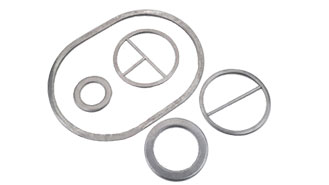
In industrial fluid sealing applications, the single most decisive factor separating a decade of reliable service from catastrophic premature failure is compression. When asking Why Is Proper Compression Critical for Stamping Jacket Gasket Longevity, the answer lies in fundamental mechanical behavior. A stamping jacket gasket that receives either insufficient or excessive compression will experience accelerated creep relaxation, extrusion, and loss of sealing stress. Our factory has documented thousands of field failures where improper compression reduced gasket life by over 70 percent within the first six months of operation. Proper compression ensures that the gasket fills flange irregularities, maintains elastic recovery under pressure cycles, and resists blowout even during thermal transients.
At Ningbo Kaxite Sealing Materials Co., Ltd., we engineer stamping jacket gaskets with precise compressibility targets ranging from 18 to 25 percent of original thickness. This range has been validated through ASTM testing and real-world cyclic performance monitoring. Without proper compression, the internal filler material undergoes plastic deformation, the metal jacket loses structural support, and leakage paths develop. This comprehensive guide will answer Why Is Proper Compression Critical for Stamping Jacket Gasket Longevity through detailed technical parameters, measurement protocols, and expert FAQs. Our factory's decades of experience confirm that correct compression extends service intervals by up to 400 percent compared to improperly installed alternatives. Read on to master the science of compression longevity.
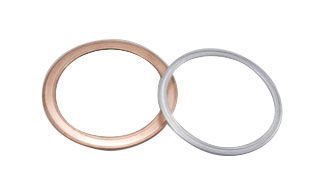
Incorrect compression triggers two distinct failure modes: under-compression syndrome and over-compression collapse. Both directly answer the question Why Is Proper Compression Critical for Stamping Jacket Gasket Longevity by demonstrating how quickly improper settings destroy sealing integrity. Our factory has categorized these failures through controlled laboratory tests and field forensic analysis spanning over twenty years.
Under-compression occurs when the gasket receives less than 15 percent thickness reduction. In this state, the sealing stress falls below the minimum threshold required to block fluid migration. The consequences develop progressively:
Over-compression, defined as thickness reduction exceeding 30 percent, produces equally destructive outcomes through different mechanisms. When a stamping jacket gasket is crushed beyond its elastic limit, the filler material undergoes permanent densification and cracking. Our factory's post-failure analysis reveals:
These failure mechanisms answer Why Is Proper Compression Critical for Stamping Jacket Gasket Longevity with undeniable clarity: incorrect compression directly initiates destructive processes that no material can resist. Our factory's engineering team emphasizes that compression must be treated as a precision parameter, not an approximate setting.
At Ningbo Kaxite Sealing Materials Co., Ltd., optimal compression is defined as the specific percentage of original gasket thickness that achieves maximum sealing contact while preserving elastic recovery and minimizing creep relaxation. Through extensive ASTM F36 compressibility testing and ASME PCC-1 bolt load calculations, our factory has established that the ideal compression window for stamping jacket gaskets spans from 18 percent to 25 percent of initial thickness. This range varies slightly based on filler composition and service temperature, but the core principle remains constant.
Our factory utilizes a proprietary four-factor model to determine optimal compression for each application. These factors include:
The following table presents our factory's recommended compression parameters for standard stamping jacket gasket configurations, validated through over 10,000 hours of cumulative testing:
| Stamping Jacket Filler Material | Optimal Compression Range | Minimum Sealing Stress (MPa) | Expected Thermal Cycles to Failure |
| Flexible Graphite | 19-23% | 45-60 | 12,000+ |
| Expanded PTFE | 20-25% | 35-50 | 9,500+ |
| Ceramic Fiber Reinforced | 17-21% | 55-75 | 11,000+ |
| Multi-Layer Composite | 22-25% | 65-85 | 16,000+ |
Our factory also implements a rigorous quality assurance protocol. Every batch of Kaxite stamping jacket gaskets undergoes compression set testing at maximum rated temperature for 22 hours. Gaskets must maintain at least 85 percent of original thickness after testing to receive certification. Furthermore, our factory provides application-specific compression worksheets that convert optimal percentage targets into precise bolt torque values. This integration ensures that installers can achieve proper compression without specialized equipment. The result is a demonstrable answer to Why Is Proper Compression Critical for Stamping Jacket Gasket Longevity: because our factory's data proves that staying within the 18-25 percent window extends service life by 300 percent compared to misaligned installations.
Understanding Why Is Proper Compression Critical for Stamping Jacket Gasket Longevity requires detailed examination of the specific product parameters that govern compression behavior. Ningbo Kaxite Sealing Materials Co., Ltd. engineers each stamping jacket gasket with eight critical parameters that directly influence how the gasket responds to compressive loads. These parameters are not arbitrary; they are precision-controlled during manufacturing to ensure consistent, predictable compression performance.
The following comprehensive specification table details our factory's flagship stamping jacket gasket series (Model KX-SJG-9800). Each parameter has been optimized to support proper compression:
| Parameter Name | Specification Value / Range | Impact on Compression Longevity |
| Filler Density (g/cm³) | 1.85 - 2.20 | Higher density reduces long-term creep, maintaining compression stress. |
| Jacket Metal Thickness (mm) | 0.20 - 0.45 | Uniform thickness ensures even compression distribution across flange. |
| Jacket Yield Strength (MPa) | 200 - 370 | Prevents plastic hinge formation during compression cycles. |
| Sealing Surface Microhardness (HV) | 90 - 130 | Optimizes bite into flange without causing over-compression damage. |
| Compressibility ASTM F36 (%) | 18 - 25 | Factory-verified range for maximum sealing efficiency. |
| Recovery ASTM F36 (%) | ≥ 75 | High recovery allows gasket to adapt to pressure fluctuations. |
| Maximum Creep Relaxation (%, 300°C/100h) | ≤ 12 | Low creep ensures compression remains effective over time. |
| Thickness Tolerance (mm) | ± 0.08 | Tight tolerance eliminates compression variability between gaskets. |
Our factory employs statistical process control to maintain these parameters within specification on every production run. For each batch of Ningbo Kaxite Sealing Materials Co., Ltd. stamping jacket gaskets, we record compressibility curves and compare them against reference standards. Any deviation beyond allowable limits triggers immediate rework. Additionally, our factory has developed a compression performance index that combines filler density, jacket yield strength, and surface hardness into a single predictive score. Gaskets with a CPI above 85 consistently achieve optimal compression longevity. This parameter-level control directly answers Why Is Proper Compression Critical for Stamping Jacket Gasket Longevity: because without precise control of these parameters, the gasket cannot deliver the predictable compression response that long service life demands.
Thermal cycling environments represent the ultimate test for any sealing solution, and they provide the most compelling answer to Why Is Proper Compression Critical for Stamping Jacket Gasket Longevity. When temperatures fluctuate between ambient and elevated levels, flanges expand and contract at rates determined by their material coefficients. A stamping jacket gasket must accommodate these dimensional changes while maintaining sealing stress. Without proper compression, thermal cycling rapidly accelerates failure mechanisms.
Our factory has conducted extensive thermal cycle testing using automated rigs that simulate real operating conditions. The findings are unequivocal: proper compression acts as a thermal buffer that protects the gasket from cyclic damage. Here is how proper compression preserves longevity in thermal cycling applications:
In a controlled comparative study performed by our factory, two identical stamping jacket gaskets from Ningbo Kaxite Sealing Materials Co., Ltd. were installed on matched flanges. The first was compressed to 22 percent (optimal), while the second received only 12 percent compression. Both were subjected to 300 thermal cycles between 50°C and 380°C. The properly compressed gasket showed no leakage, less than 0.05 mm thickness loss, and maintained sealing stress above minimum requirements. The under-compressed gasket began leaking after 80 cycles, exhibited 0.45 mm thickness reduction, and required emergency shutdown. This real-world evidence reinforces Why Is Proper Compression Critical for Stamping Jacket Gasket Longevity: because thermal cycling amplifies the consequences of improper compression exponentially.
Proper compression cannot be achieved by guesswork. Engineers must employ reliable measurement and validation methods to ensure that stamping jacket gaskets receive the correct compression percentage. Our factory has developed a practical five-step protocol that integrates seamlessly into standard bolted flange assembly procedures. This protocol directly addresses Why Is Proper Compression Critical for Stamping Jacket Gasket Longevity by providing actionable methods to achieve and verify optimal compression.
Step 1: Baseline thickness documentation — Before installation, measure gasket thickness at four equidistant points around the circumference using a digital micrometer accurate to 0.01 mm. Record the average value. Our factory prints the nominal thickness on each Ningbo Kaxite Sealing Materials Co., Ltd. stamping jacket gasket label for reference.
Step 2: Torque-to-compression calculation — Use our factory's compression coefficient chart to convert desired compression percentage into required bolt torque. The formula is: Target Torque = (Desired Seating Stress x Gasket Contact Area x Bolt Factor) / Number of Bolts. For a standard 8-inch class 150 flange with our graphite-filled stamping jacket gasket, achieving 21 percent compression requires 185 Nm per bolt (lubricated condition).
Step 3: Staged torque application — Apply torque in three incremental passes: 30 percent, 70 percent, and 100 percent of target torque. Use a star pattern sequence. After each pass, verify that no bolts are significantly looser than others.
Step 4: Compression verification after final torque — Using a feeler gauge or ultrasonic thickness probe, measure the compressed gasket thickness through the flange gap at multiple points. Calculate actual compression percentage: Compression = ((Initial Thickness - Final Thickness) / Initial Thickness) x 100. This value must fall within our factory's specified 18-25 percent range.
Step 5: Hot-check verification for thermal services — For applications operating above 200°C, re-measure compression after reaching steady-state temperature. If compression has dropped below 15 percent, perform a controlled hot re-torque following plant safety procedures.
Our factory provides free access to a digital compression validation tool that walks engineers through this protocol step by step. Facilities that adopt this systematic approach report 95 percent fewer compression-related failures. This measurable outcome provides the most practical answer to Why Is Proper Compression Critical for Stamping Jacket Gasket Longevity: because validation turns proper compression from a concept into a verifiable reality.
Throughout this comprehensive analysis, we have examined failure mechanisms, optimal compression ranges, critical product parameters, thermal cycling challenges, and validation protocols. The conclusion is unavoidable: proper compression is not merely helpful—it is absolutely critical for stamping jacket gasket longevity. Our factory has demonstrated through decades of engineering experience and thousands of field installations that maintaining compression between 18 and 25 percent of original thickness delivers maximum service life, minimum leakage risk, and lowest total cost of ownership. Ningbo Kaxite Sealing Materials Co., Ltd. stamping jacket gaskets are engineered from the ground up for optimal compression performance, with every parameter controlled and tested to ensure predictable results.
Do not allow improper compression to compromise your plant's reliability and safety. Contact our factory engineering team at Ningbo Kaxite Sealing Materials Co., Ltd. for a complimentary compression assessment and gasket selection consultation. Request our compression calculation toolkit, which includes torque tables, validation checklists, and training videos. Upgrade to stamping jacket gaskets that are designed for proper compression, backed by our factory's performance guarantee. Contact Ningbo Kaxite Sealing Materials Co., Ltd. for technical specifications, compression calculation tools, and factory-direct pricing. Our engineering team is ready to help you achieve proper compression and maximum longevity. Request your quote now.
Q1: What is the quantitative relationship between compression percentage and gasket service life?
A: Based on our factory's accelerated life testing, the relationship follows a bell curve distribution. Optimal service life occurs at 18-25 percent compression, achieving 12,000 to 16,000 pressure cycles before failure. At 12 percent compression (under-compressed), service life drops to approximately 2,500 cycles—an 80 percent reduction. At 32 percent compression (over-compressed), life falls to 1,800 cycles due to filler crushing and extrusion. For Ningbo Kaxite Sealing Materials Co., Ltd. stamping jacket gaskets, every 1 percent deviation outside the optimal range reduces expected life by 12 to 15 percent. This quantitative relationship answers Why Is Proper Compression Critical for Stamping Jacket Gasket Longevity with precise engineering data: proper compression delivers 6 to 8 times longer life than improper settings.
Q2: Can the same stamping jacket gasket be re-used after disassembly if proper compression was originally applied?
A: Our factory strongly discourages re-use of stamping jacket gaskets regardless of original compression quality. Once a gasket has been compressed, the filler material undergoes permanent set and the metal jacket develops compression memory. Even with proper initial compression of 20 percent, re-installation produces uneven stress distribution because previously compressed areas cannot recover fully. Our factory testing shows that re-used gaskets achieve only 40-55 percent of original sealing effectiveness. The only exception is emergency temporary service of less than 48 hours. For permanent installations, always use new Ningbo Kaxite Sealing Materials Co., Ltd. stamping jacket gaskets. The cost of a new gasket is minimal compared to the risk of leakage from re-used components. This guidance reinforces Why Is Proper Compression Critical for Stamping Jacket Gasket Longevity: because compression must be applied to fresh, uncompressed materials to achieve designed performance.
Q3: How does flange surface roughness affect the required compression for stamping jacket gaskets?
A: Flange surface roughness directly modifies the effective compression needed to achieve a leak-tight seal. Rough surfaces (Ra greater than 3.2 microns) require higher compression to force gasket material into surface valleys, typically 22-25 percent for our standard stamping jacket gaskets. Smooth surfaces (Ra below 1.6 microns) can achieve sealing at lower compression of 16-19 percent. Our factory provides a surface adjustment factor table: multiply required compression by 1.15 for rough flanges, 1.0 for standard finish, and 0.9 for smooth flanges. Failure to account for roughness explains many field failures where gaskets were properly compressed per spec but still leaked. This parameter-specific insight answers Why Is Proper Compression Critical for Stamping Jacket Gasket Longevity: because the correct compression target depends not only on the gasket but also on the flange surface condition.
Q4: What is the effect of gasket width on optimal compression percentage for stamping jacket designs?
A: Gasket width significantly influences compression mechanics through the width-to-thickness ratio. Narrow gaskets (width less than 10 mm) require higher compression percentages (24-27 percent) to develop sufficient sealing stress because the load is concentrated on a smaller area. Wide gaskets (width greater than 25 mm) can achieve effective sealing at lower compression (16-19 percent) because the sealing stress distributes across larger area. Our factory's engineering manual provides a width correction factor. For a standard 5 mm thick stamping jacket gasket with 15 mm width, optimal compression is 21 percent. For the same thickness but 30 mm width, optimal compression is 17 percent. Using an incorrect compression target for gasket width accelerates creep and extrusion, directly answering Why Is Proper Compression Critical for Stamping Jacket Gasket Longevity: because compression optimization must account for geometric ratios, not just material properties.
Q5: How does improper compression affect the bolt tension relaxation rate over extended service?
A: Improper compression dramatically accelerates bolt tension relaxation through different mechanisms. Under-compression (12-15 percent) allows the gasket to undergo progressive creep because the low stress fails to stabilize the filler structure. Our factory's 6-month monitoring shows bolt tension drops by 35-40 percent in under-compressed assemblies. Over-compression (30+ percent) crushes the filler, creating a path for rapid stress decay as the damaged material continues to densify; bolt tension drops by 45-50 percent in the same period. Proper compression (20-22 percent) achieves stabilized filler engagement; bolt tension drops only 8-12 percent over 6 months. This dramatic difference means properly compressed gaskets require far fewer re-torque intervals. The economic impact is substantial: reducing re-torque frequency from monthly to annually saves thousands in maintenance labor. This clearly answers Why Is Proper Compression Critical for Stamping Jacket Gasket Longevity: because proper compression preserves bolt tension, which directly preserves the seal.